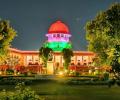
The Centre told the Supreme Court that governors are not indefinitely sitting on bills passed by state legislatures, and that barring a few exceptions, most have acted in a way which the apex court would have perhaps desired. Solicitor General Tushar Mehta argued that a Governor is "not a rubber stamp" and has a duty to preserve, protect, and defend the Constitution.

Salient features of the National Sports Governance Bill that promise to overhaul several aspects of sports governance and the grievance redressal system for athletes and administrators alike in the country.

Both factions of the Jamiat Ulema-e-Hind (Arshad Madani and Mahmood Madani) slammed the Bill and expressed grave concerns over the proposed legislation.
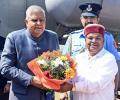
Karnataka Governor Thaawarchand Gehlot has reserved the Bill pertaining to four percent reservation for Muslims in government contracts for the President's assent, citing constitutional concerns. The Bill, which has been a subject of controversy in Karnataka, was passed by both houses of the state legislature amid protests from the opposition BJP. The Governor's decision to reserve the Bill highlights the ongoing debate over the constitutionality of religious-based reservations in India.

The National Sports Governance Bill has become an Act after President Droupadi Murmu gave her assent to the landmark legislation that promises to revamp India's sports administration.

Maharashtra Deputy Chief Minister Ajit Pawar on Saturday said officials responsible for registering documents should have refused to process agreements that were not permissible under the law and clearly informed the parties concerned about such limitations.
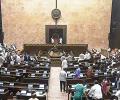
The Rajya Sabha, India's upper house of parliament, witnessed its second-longest sitting in history on Thursday, lasting until 4:02 am the next day. The House convened to clear the Waqf (Amendment) Bill and approve the statutory resolution on the imposition of President's Rule in Manipur. The longest sitting in Rajya Sabha history occurred on September 17, 1981, when the House sat until 4:43 am to pass the Essential Services Maintenance Bill.

Estranged TMC MLA Humayun Kabir's plan to build a mosque modeled on the Babri Masjid in Murshidabad has sparked a political firestorm in West Bengal, with accusations and warnings escalating tensions ahead of state elections.

Six bills, including the one to amend the Jammu and Kashmir Reorganisation Act, were introduced in the Lok Sabha on Wednesday amid protests by opposition members over the violence in Manipur.
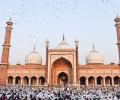
'Only because of the absence of a dedication record in writing, how can such properties be treated as located on misappropriated government land?'

'The new Bill introduces no policy or rate changes, leaving financial planning strategies largely unaffected.'
'The considerations for choosing between the old and new tax regimes remain essentially unchanged.'
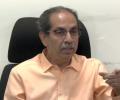
Shiv Sena (UBT) chief Uddhav Thackeray has slammed the BJP over its stance on the Waqf Amendment Bill, accusing the party of a "fraudulent" approach and of trying to take away land for its industrialist friends. He also dared the BJP to remove the green color from its party flag if it disliked Muslims. Thackeray's comments come after the bill was passed by the Lok Sabha on Thursday.

AICC general secretary K C Venugopal announced the Congress party's goal to win 100 seats in the upcoming Kerala Assembly elections. He highlighted the party's strategy, including early candidate selection, opportunities for youth, and addressing alleged alliances between CPI(M) and BJP.

'When the Bill was passed all have been exposed. There is no difference between communal and secular.'
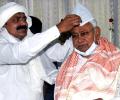
'Muslims in Bihar under Nitishji's rule are safest than anywhere else.'

The Union Cabinet on Friday approved 100 per cent foreign direct investment (FDI) in the insurance sector, a move that was welcomed by industry as it would help attract more capital and global expertise, while boosting insurance coverage in the country. A bill to amend the insurance law is likely to be tabled on Monday in Parliament, whose winter session is slated to conclude on December 19.

InterGlobe Aviation, the operator of IndiGo, has approached the Delhi high court seeking a refund of over Rs 900 crore it claims to have paid as Customs duty on aircraft engines and parts re-imported into India after overseas repairs. The petition came up for hearing on Friday before a bench of Justices Prathiba M Singh and Shail Jain.

The Bharatiya Janata Party is inquiring into the absence of its nearly 20 MPs from the Lok Sabha during the voting on Tuesday on the introduction of the bill for simultaneous elections.

The legislation sets clear expectations for National Sports Federations and the Indian Olympic Association, ensuring mechanisms for fair elections, financial openness, and inclusive representation.

The bill aims to include all the Muslims sects in the Waqf board, Rijiju said.

Himachal is first state in the country to pass such a bill under which "A person shall not be entitled for pension under the Act, if he has been disqualified at any point of time under the tenth schedule of the Constitution".

The high court also instructed both the Mamata government and the Centre to submit detailed reports on the situation. The matter is scheduled for further hearing on April 17.

Two individuals claiming to be members of the Janata Dal (United) (JD(U)) in Bihar announced their "resignation" from the party, citing dissatisfaction with its support for the Waqf (Amendment) Bill. The JD(U) denied the resignations, claiming the individuals were not party members. However, some senior JD(U) leaders have expressed discontent over the passage of the bill, which they believe is detrimental to Muslims. The controversy over the Waqf Bill is likely to influence the upcoming assembly elections in Bihar.

A meeting of the joint committee of Parliament on the Waqf (Amendment) Bill on Friday witnessed fireworks with members vociferously opposing certain provisions of the draft legislation, leading to a brief walkout by opposition members.

The power sector presents a puzzle. A fast-growing economy should be aligned to higher power demand but that hasn't been the case in the financial year 2026 till date (FY26TD).

The changes suggested include the amendment to the provisions of the Constitution relating to preparation of the electoral roll by the Election Commission of India in consultation with the State Election Commission(s) for the elections to the local bodies (in Article 325).
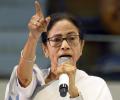
Banerjee said she will protect the minority people and their property.
The Centre has told the Supreme Court that imposing fixed timelines on governors and the president to act on bills passed by a state Assembly would amount to one organ of the government assuming powers not vested in it by the Constitution and lead to a "constitutional disorder".

The bill to amend the law governing Waqf boards proposes far-reaching changes in the Wakf Act, 1995, including ensuring the representation of Muslim women and non-Muslims in such bodies.
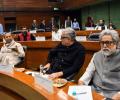
India's Parliament is set to begin its Budget session on Friday, with opposition parties poised to demand a discussion on the alleged mismanagement of the Maha Kumbh festival in Prayagraj, where 30 pilgrims died in a stampede. The opposition also accused the government of politicising parliamentary committees and pushing its agenda through its majority. The session will start with President Droupadi Murmu addressing both houses of Parliament. Finance Minister Nirmala Sitharaman will present the Union Budget on Saturday for the eighth consecutive time.

'So, they have taken away the word Waqf from the Bill.' 'It will now be known as the UMEED Act.'
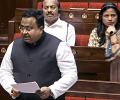
Amid a row over change in stand over voting on the Waqf (Amendment) Bill, 2025, the Biju Janata Dal (BJD) on Friday asserted it is a secular regional outfit and maintains equal distance from the Bharatiya Janata Party-led National Democratic Alliance and the opposition Indian National Democratic Inclusive Alliance bloc led by the Congress.

The Mamata Banerjee government will table the anti-rape bill in the West Bengal Assembly on Tuesday.
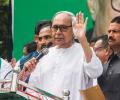
A section of Biju Janata Dal (BJD) leaders in Odisha are expressing discontent over the party's decision to support the Waqf (Amendment) Bill. The issue has sparked internal turmoil, with young leaders submitting a memorandum to party president Naveen Patnaik, urging him to address the situation. Patnaik has held meetings with senior leaders, assuring them that necessary action will be taken to mitigate the fallout and maintain the party's secular image.
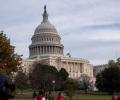
On the 40th day of the most extended government shutdown in US history, senators returned from recess Sunday for a rare weekend session, preparing to vote on whether to advance a House-passed spending bill aimed at reopening the government.

A chance meeting between Jammu and Kashmir Chief Minister Omar Abdullah and Union minister Kiren Rijiju at the Tulip Garden in Srinagar has sparked a political storm, with opposition parties accusing the National Conference of laying out a red carpet for the BJP leader in the aftermath of the Waqf Amendment Act. While NC sources termed the interaction as a purely coincidental encounter, opposition parties like the PDP and Peoples' Conference condemned the meeting, accusing the NC of surrendering to the BJP. The Waqf (Amendment) Bill, passed by Parliament last week, aims to streamline the management of Waqf properties with provisions to safeguard heritage sites and promote social welfare.

Opposition MPs, some of whom have given their dissent, slammed the exercise as undemocratic, claiming that they were given little time to study the final report and frame their dissent notes.

This was probably the largest such gathering in the country to protest the Waqf (Amendment) Act.
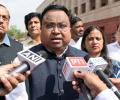
Senior leaders of the Biju Janata Dal (BJD) in India are calling for action against Rajya Sabha MP and national spokesperson Sasmit Patra for allegedly creating confusion among lawmakers regarding the Waqf (Amendment) Bill. The controversy arose after Patra, despite the party's announced opposition to the Bill, revealed he had voted in favor of it and stated that MPs could vote according to their conscience. The situation has led to accusations of a possible "deal" between the BJD and the Bharatiya Janata Party (BJP).
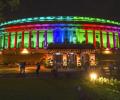
The Centre has also listed 24 bills, including the Cantonment Bill, the Multi-State Cooperative Societies (Amendment) Bill and the Insolvency and Bankruptcy Code (Amendment) Bill.
